Signs Abroad

If you follow this blog you know by now, that I always take with me a book or two when going abroad, but don't always get to read them. However, being a compulsive reader, I do read other things -- anything within sight.

On our most recent trip, earlier in October (2009), we rented (or hired) a car and toured Cornwall for a few days. Plus a bit of Somerset on the way. One of our last stops was St. Just -- just a little town, nothing special. If you follow the link you'll see the little town square where we parked our blue Seat Leon. But a short drive west brings you to Cape Cornwall -- with a beautiful view of the ocean and a hill with a pillar on top.

Anyway, wandering and admiring the view, I came upon this here bench and sign:


Upon closer inspection, the sign says:


[In case pic isn't clear, the offending phrase is: "The National Trust... needs money for it's work..."]

Well! Who'd have thunk it? Literally carved in stone, for the whole tourist world to see, such a boo-boo!
Haven't written yet to the National Trust. At the bottom, hidden by grass, it says "Please will you help?"
I certainly shall, by sending them a link to this post. Mind you, I'm afraid correcting a mistake etched in stone is rather a nuisance compared to correcting a printing error. On the other hand, who knows how many such stones the National Trust has scattered all over the UK... Wonder if they all contain the same mistake...

But I did also learn something on this same grassy patch, from yet another sign -- click on pic to enlarge and read:
(Should have moved aside a certain blade of grass]


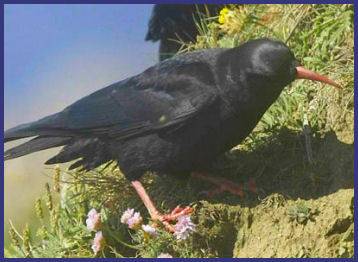
Until I reached the end of the text, I had no idea what a chough was. Did you?
The case against automatic translation tools?...

My daughter Shira recently signed up for an online newsletter on landscape architecture. The publishing house is German, but the website is in perfectly good English, as well it should be. Um, that is, most of it is. Something seems to have slipped through the cracks. The site editor must have dozed off and forgot to polish a certain machine-generated paragraph. (Just a theory.)

The newsletter registration page is quite normal, until the last paragraph, which reads: [Read aloud for maximum effect]
--------------------

Data protection: Their email address is used only for the dispatch of our own information. We pass your address on not to third and dispatch also no advertisement of third. At the end of each newsletter a comfortable notice possibility exists. The Klicks on hyperlinks in emails and on web pages is made measured anonymous. The education of personal user profiles without your agreement is impossible thereby.

--------------------

This weird text is followed by a standard Privacy Policy page.

Anyone want to point this out to the publishing house?

Translation tips –- Hebrew to English

Here are a few typical goofy translations, of the sort I encounter repeatedly.

These may not be downright awful mistakes… they're just not the best way of phrasing things:


1. From the October 26, 2009 J. Post:

"Cameri Theater actor Limor Goldstein… has responded positively to a request from the theater's manager to step in …" etc.

"Responded positively" reeks of literal translation of the ubiquitous Hebrew expression נענה בחיוב, נענתה בחיוב [na'ana be'hiyuv, na'anta be'hiyuv]

The more natural way to say it in English would be: agreed, accepted, said yes, etc.

(Yes, this would require rewriting the sentence. Piece of cake, right?)


2. From the October 21, 2009 J. Post:

"The decision on whether to close the file on Foreign Minister A. L. or to invite him to a hearing that will determine whether or not the state will press charges against him…"

Just because he's a minister, does not mean he is invited and has the option of declining the invitation… This too is a common literal translation of the Hebrew להזמין [lehazmin] which indeed usually translates as "invite". Though had the original, Hebrew writer of this article used the verb לזמן [lezamen] rather than lehazmin, the English translator would have been less likely to err (I hope.) In this case, I believe the minister was summoned. This verb is very useful in other contexts too.

In Hebrew, you use this "inviting" verb in contexts wherein you'd use a totally different verb in English:

- The headmaster / head teacher called/ summoned the parents of the unruly kid to the school. The teacher calling the parents may be very polite, but I doubt you'd call it an invitation.

- The doctor's/dentist's receptionist called to schedule an appointment for your check-up

And so on.


3. Writers of Hebrew have a fondness for the word project. Not everything is a project. Sometimes program is more apt. E.g.: "Program Objective: Locate 20 students aged 12-16 who would participate in and benefit from the program." (A program run in certain schools offering extra tutoring to pupils who need it.)


4. The Hebrew word קוסמטיקה [cosmetica]. No, it does not necessarily mean cosmetics. In Hebrew usage, this word covers everything from creams and wonder-serums to lipstick and false eyelashes. In English, there's skincare products (= creams etc) and there's cosmetics (lipstick etc.) So be on your guard.

BTW -- there is a good Hebrew word for cosmetics in Hebrew -- תמרוקים [tamrukim]. But I see that its meaning is a bit fuzzy. According to my Heb>Eng dictionary, it means both make up and creams & unguents; but according to my Heb-Heb dictionary, it refers only to skincare, not to makeup. Go figure.


5. פרס [pras] – literally – prize. But in many instances it's an award, not a prize.